Friday, December 24, 2010

"S Novym Godom!"

Shhh! Don't tell anyone, but I sneaked five men into the United States from Russia last week in my suitcase.  With their flowing robes, exquisitely decorated in rich regal colors, furry hats, pointed staffs, overstuffed bags of goodies for eager girls and boys, snowy-white beards reaching from chins to  stomachs, and rosy-cheeked faces complete with twinkling eyes and kindly smiles, these guys were no ordinary stowaways.  And talk about jolly personalities!  Their deep baritone voices sounded through the suitcase with vibrations that shook the air like bowlfuls of jiggling jelly.

Sound vaguely familiar?

In Russia, these characters are called Ded Moroz (pronounced "Dead Morose" in English).  Not quite a fitting name for such jovial gents, to our western way of thinking, but the actual translation means "Grandfather Frost," more commonly called "Father Frost."  He performs a job very similar to his more rotund, "Ho, Ho, Ho-ing" counterpart, delivering gifts to "good" little boys and girls on New Year's rather than Christmas Eve.  Much like Santa Claus, a sleigh (troika) is his favorite means of getting from house to house, but three horses rather than a team of reindeer with a red-nosed leader, speed him to the far corners of Russia.  Not crazy about sooty chimneys, Ded Moroz prefers to make more dignified entrances, through doors, and he's always accompanied by a beautiful partner. Whereas Santa Claus leaves Mrs. Claus at the North Pole during his night of gift-giving, Ded Moroz travels with his granddaughter, the Snow Maiden, or Snegurochka.  Dressed in an ice-blue robe, trimmed with white fur and a matching hat, she and Father Frost make a striking pair, often accepting invitations to children's parties during the holiday season.


Opening my bag after the long flight from Moscow to Little Rock, I wonder if my collection of Father Frosts has survived.  Did their jovial jabberings alert the customs officials who whisked them away to a dark detention room for questioning?  Did they discover how to unzip the bag and hop out at the  Houston airport, having always dreamed of exploring Texas?  Removing layers of socks, scarves, and sweaters, I find them sleeping quietly at the bottom of my black roller bag, jet lag already setting in.  After a few days of acclimating to their new Arkansas home, each Ded Moroz seems content to stand, staff in hand, adding a touch of Russian beauty and tradition to the table in our foyer.  In the middle of the night, though, I think I hear baritone voices in unison saying, "S Novym Godom!" or "Happy New Year!"


I add my greetings and best wishes to theirs for a Happy 2011!


Saturday, December 4, 2010

Haikus Written in Russia but not in Russian (Winter)

The park across the street from our Moscow apartment is my haven, a place of solitude and natural beauty in the midst of one of the largest cities in the world.  I described it in a posting called Natural Magic last May, then again in photos and poetry in "Haikus Written in Russia but not in Russian (Autumn)."
The yellow, autumn leaves are now brown and hidden under snow, the ducks have changed their address to "Somewhere Warm," and the blue waters have transformed into glistening whiteness.  Please come along with me for another walk in the woods.

     dimpled waters dance
      upon twinkled toes to an
   orchestra of wind

merry berries hang
from barren winter branches
red cheeks all aglow

 
yellow richness, you
call temptingly to me in 
joyful stickiness.
(Note - the letters on the yellow barrel, MED, spell "honey" in Russian)

icy shoreline now
deserted by fishermen
breathes in solitude

alight and refresh
in the fullness of morning
sunshine on feathers

                                                chalky Russian birch
                                                sentinel of the forest
                                               point my path towards home

Haikus © Twylla Alexander 2010


Sunday, November 28, 2010

Blending In at a Russian Rynok

There are places in Moscow where I blend in, usually big places like Red Square, the Kremlin or the Bolshoi, which literally means big.  I'm one of the crowd, a mix of nationalities.  I don't stand out any more than the next non-Russian with guidebook in one hand and camera in the other.  I take pictures, scribble thoughts in my notebook, and wander freely, usually never needing to open my mouth, read a sign or understand what a Russian says to me, because they ignore me.


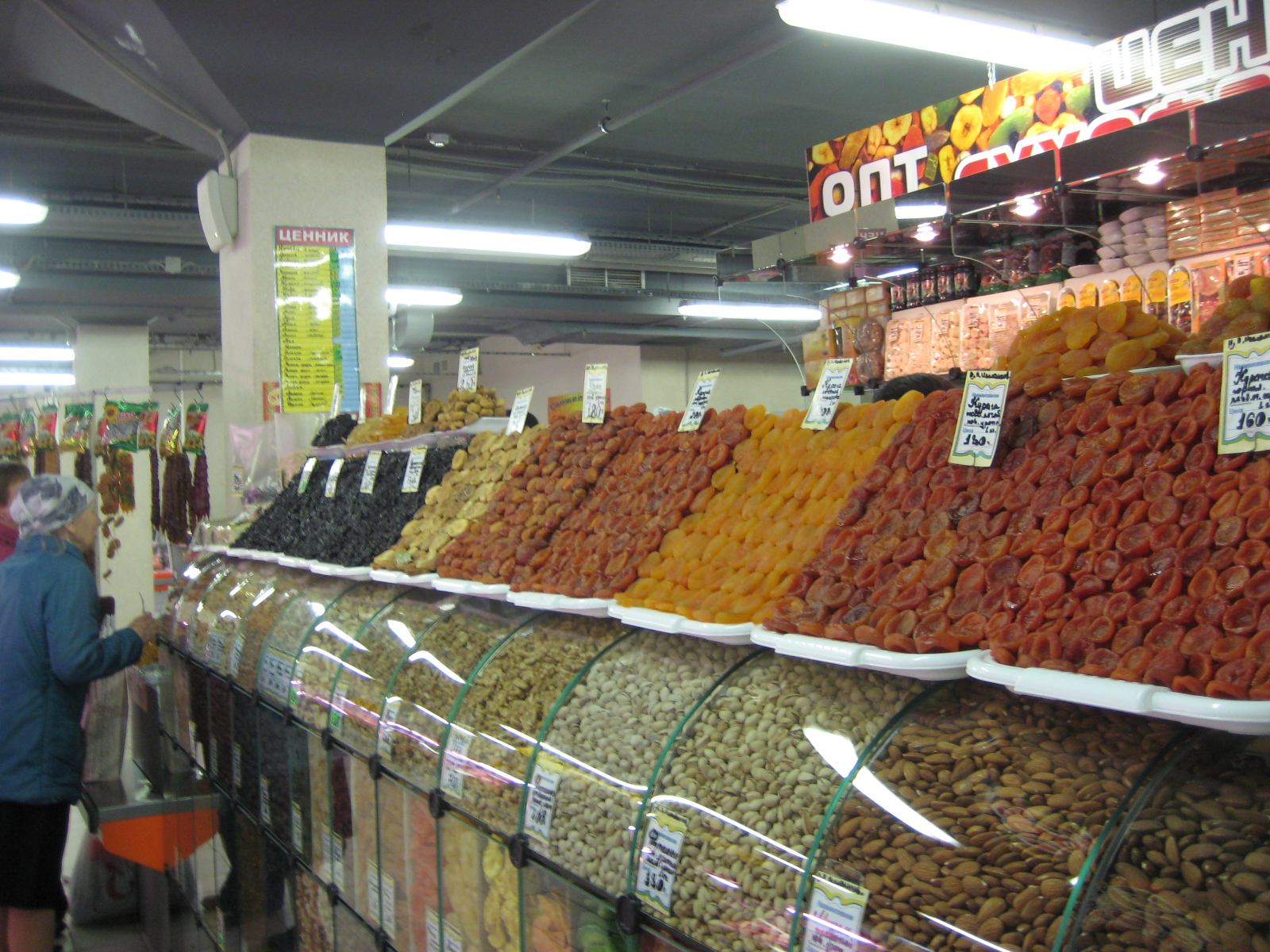
But when I descend the escalator to the rynok (reenok), or local market, near Tushinskaya metro, I enter "real" Russia.  I'm on my own and feeling more like a sore thumb the closer I get to the ground floor.  I look different from the other, mostly women, shoppers.  Not in a scary, alien kind of way, where everyone in the place freezes the second I appear, gaping at me in stunned silence.  They keep doing what they're doing, but I catch one of the lady vendors following me intently with her eyes, then two others looking in my direction, quickly turning to each other with hands covering their mouths, as if I could understand what  they were saying, anyway.  Maybe it's the attire - winter coat, without fur.   Maybe it's the white hair that I'm, unbelievably, not coloring.  Maybe it's my reputation, "The Lady Who Doesn't Speak Russian." Or maybe it's my tote bag.  READ GREEN, written in yellow, displaying Barbara Kingsolver's book, Animal, Vegetable, Miracle."


Today I want to take a few pictures for my blog, but feel more like a spy with a secret camera in her pocket than a mild-mannered housewife with vegetables on her mind.  Actually, I do have a camera in my pocket, but am afraid to use it.  I've learned to take pictures with caution and only in those big, open touristy places.  I made the mistake of snapping a photo of the above-ground entrance to a metro station a couple of years ago, just to show the folks back home where I catch the nearest train.  Before I could put the camera in my purse and walk to the bottom of the stairs, I was surrounded by 3 uniformed individuals, two men and a woman, whose only and most frequent word in Russian I could understand was "Nyet!"  Where had they come from? I got the message quickly that taking pictures anywhere close to a metro is NOT ALLOWED, which makes perfect sense, especially with the subsequent bombings last year.


Think about it.  If you were standing behind piles of potatoes, turnips, purple onions and beets, and a white-haired lady wearing a puffy down jacket which made her look like a black marshmallow with a head, pulled a camera out of her cryptic bag and started taking pictures of you and your veggies, wouldn't you be skeptical?  I'm not a total stranger to the rynok, having frequented it at least 10 times before, but it's a big place, about half the size of a football field.  There are the dairy counters with the "cheese ladies," as I describe them, the nut cases with the "nut guys," the leafy greens with the "greens ladies," the honey, meat, fruits, vegetables, bread, dried fish, biscuits, flowers, and more I've never explored.


I decide to take a chance with four vendors with whom I have a "relationship," ones I return to each time, appreciating their patience with my gestures and limited "rynok Russian." Holding up my camera and asking, "Can I take a picture?" as I point toward their wares, I smile and try to look the least like Angelina Jolie (Salt) as possible.  Not a hard task.  Each one nods, kindly but slowly, trying to be accommodating to this American lady, but not quite sure why she wants to take pictures of food.  None wants to be in the picture, though.  The "bread lady" scoots under the counter to get totally out of the way; the "fruit lady" moves to the side; the "nut guy" ducks behind the almonds, and the "greens lady" gets involved with another customer.  (I sneak her into the picture, however, as I fake aiming only at the lettuce.) Maybe there's a little spy in me, after all.


I walk the half hour route back to our apartment, camera safely nestled in my bag among the walnuts, bread and basil.  I download the pictures as I unload the groceries, then sit back for a cup of tea and exhale. "Mission accomplished!"  


Monday, November 22, 2010

Happy Birthday, Abigail!

It's a total stretch to find a link between Abigail Adams and Arkansas or Russia.  Her oldest son, John Quincy, did serve as the United States' Minister to Russia from 1809-1814, and I'm sure that she learned about the country from his letters and personal narratives.  But that's as close as it gets.  There are some stories just waiting to be told, though, remaining dormant in the writer's storehouse of possibilities, until the right moment.  When I read today's online edition of The Writer's Almanac and learned that it is Abigail's birthday (New Style calendar), I knew that the time had come.  (I will post a Russian story later in the week, but for now, indulge me.)

I walk in the front door of the Massachusetts Historical Society in February, 2010 looking for a connection, a real, hands-on connection to Abigail.  I had recently watched the HBO miniseries, "John Adams," listened to David McCullough's book on which it is based, and read My Dearest Friend Letters of Abigail and John Adams, containing the most recently published collection of  letters between the second U.S. president and his wife. The entire collection contains over one thousand letters, and I learned that the originals are housed in this building, this very building, only a 6 block walk from our hotel!  To see an actual letter, the handwriting of this woman I have grown to admire so much, leaves me breathless, not to mention the brisk walk on a cold Boston morning.

Why?  Why Abigail?
Portrait of Abigail Adams, shortly after marriage to John, 1766
Massachusetts Historical Society
"Good question," as persons being interviewed often say, when they have pondered the same issue and not arrived at a firm conclusion.   Is she that different from thousands, perhaps millions, of other women who have held their families together while the husband has been away much of the time, managing, in her case, a farm, the meager finances, raising and often educating 4 children, and grieving the death of two others?  Devoted to her husband, as many wives/partners are, she supported him with a listening ear and astute advice based on reading and study.  Wife and mother, yet still remaining Abigail, with strong opinions and beliefs that transcended day to day life.  Proponent of  equal education for girls and rights for women and opponent of slavery, she advocated for these causes in her letters to John and in her actions. All qualities much to be admired, indeed.

Still, there's something more that draws me to her.  She was a writer.  She needed to write.  It's how she coped, how she expressed what was gnawing at her from the inside.  The pen was her connection to her "self," her husband and the friends and family with whom she corresponded throughout her life.  Joseph Ellis, in his introduction to My Dearest Friend Letters of Abigail and John Adams, shares a quote from a letter that Abigail wrote to John in 1776 shortly after her mother, Elizabeth Quincy Smith, had died and Abigail had delivered a stillborn daughter, Elizabeth.  "There are particular times when I feel such an uneasiness such a rest less ness, as neither company Books family Cares or any other thing will remove. My pen is my only pleasure, and writing to you the composure of my mind." (original spelling)

Approaching the desk at the MHS, I ask if I can view some of the letters and am told, kindly but firmly, that they are not on public display, that I can see them on microfilm.  Disappointed, I adhere to the rules, secretly hoping that somehow, by some stroke of luck, I will still get to see one.  After 2 hours of less-than-satisfing microfilm viewing, I gather my hat, coat and gloves.  Seeing a lady sitting at a desk in the reading room, I take a risk.  "Excuse me, is there any chance that I could see just one of Abigail's original letters?" I ask in my kindest, most pitiful sounding voice.  "Weeell," she says scanning the room, which only contains one other person, "since there aren't many people here today, I guess I could run upstairs and get one for you."  On the inside, I'm jumping for joy, but simply say, "Oh, how nice of you!  I really appreciate it."

The letter is housed in a box, in a single manila folder.  She lays it flat on a table. I look upon a piece of paper that has a parchment-like quality, covered with a full page of swirling letters, written in brown ink, or perhaps the color reflects the passage of time.  Abigail's own hand. Abigail writing to John on March 31, 1776,
       "I long to hear that you have declared an independency.  And, by the way, in the new code of laws which I suppose it will be necessary for you to make, I desire you would remember the ladies and be more generous and favorable to them than your ancestors."


As tears begin to flood my vision, I thank the lady again, and walk into a gust of strong wind.  


Friday, November 19, 2010

"Back in the USSR!"

Every time I've traveled from Arkansas to Russia, I've been tempted to title a posting, "Back in the USSR," but have resisted.  "Too corny, too trite, too politically incorrect," I've reasoned and opted for something more . . . literary. Call it coincidence, the work of cosmic forces, or an Apple executive with knowledge of my travel plans, but the very day I returned to Moscow, the company changed its "start page," and using the taboo title instead felt fated.  Trying to stay awake the afternoon of my arrival, I opened my computer expecting to find the screen filled with the same Apple ads, new products, list of tutorials, and picture of Steve Jobs delivering his latest keynote address.  Instead, staring directly at me, from left to right, were George, Paul, John and Ringo.  "The Beatles. Now on iTunes."

It's a sign.  Forget the fact that there's no longer a "USSR," to get back to, but rather a "Russian Federation."  Try fitting those 6 syllables into the song.  Even the genius of Lennon and McCartney at their song-writing best, couldn't have pulled that one off.   I was destined to connect this week's writing to these heartthrobs of my almost-adolescent youth; the only question remains, "What's the connection to my recent transition back to Moscow besides the obvious?"  The answer lies within the question itself.

Transition or T-Word, as I not so lovingly named it in an earlier blog entry.

I was 12 when the Beatles performed on the Ed Sullivan show.  I somehow convinced (more like begged) my parents to skip Sunday night church,"just once" so I could watch.  Considering that my father called them the "Mop Heads," it's obvious that God must have been a Beatles' fan and had a hand in Daddy's decision to say "yes."  The following week when I bought their LP, without a record player in the house on which to play it, God again came through.  Perhaps he whispered in Daddy's ear, "Go buy a record player," over and over until my father could no longer withstand the pressure from the Divine and his daughter who kept whining, "Please, please, please get a record player."

Looking back on the album's cover,

 I realize that it was the Beatles who pushed me over the edge from childhood to adolescence.  I was in love for the first time, with Paul, along with a horde of millions.  The way he shook his head as he sang, "Oooooo," the way his "long" hair fell just shy of his dark eyebrows, and those penetrating chocolate brown eyes.  I sat staring at his picture for hours, dreaming that he secretly knew about me and would find a way for us to meet.  To prepare myself for that event, I took up dancing (not sure why I thought that would impress him) in my friend's attic bedroom.  Her big sister taught us a made-up version of line dancing, and we traveled from one end of her room to the other to the beat of "I Want to Hold Your Hand," until the rug showed signs of a nervous breakdown.

Adolescence is the first transition (major upheaval) I can recall, but it took another 40 years or so before I learned the terminology and strategies to cope with such changes. Having transitioned through marriage, childbirth (3 times), death of a parent and 2 grandparents, moves to Alaska, Singapore, Cairo, Arkansas and Moscow, marriage of 2 children and another in February, birth of 4 grandchildren, to name roughly the Top Ten, being "Back in the USSR" seems like "another day at the office."

"Gee, it's good to be home," is a literal lyric I'm learning to apply to Arkansas, Moscow or wherever my family is.  As a metaphor, it speaks to the woman I've become, the one I'm "at home" with, and the one who, thank goodness, is no longer an adolescent.

As for Paul,  he's still around at 68.  Perhaps there's yet a chance. . . that he, Drew and I could meet for a cup of tea.